Risk & Opportunity
Stop Keeping It In People’s Heads
Risk and opportunity are always moving. The only question is whether they’re visible and controlled, or hidden and expensive. When they live in people’s heads instead of a system, risks surface late as shocks and rework, and opportunities are missed or captured too late to meaningfully improve the outcome.

The problem is three-fold. At the project level, teams rarely have one central place to capture, quantify, and own risks and opportunities as the design evolves, so critical knowledge ends up scattered across conversations, emails, and memory. At the executive level, leadership has limited visibility into how sensitive the cost plan really is, what assumptions are holding it together, and what exposure or upside sits behind the headline number. At the client level, movement in the cost plan can feel random or reactive when risks, opportunities, assumptions, and changes are not clearly communicated. The result is a reliance gap: teams lose control, forecasts are harder to trust, clients lose confidence, decisions take longer, and leaders are forced into micromanagement just to understand what is happening.
Solving this creates a practical operating system for risk and opportunity. Teams gain a disciplined way to surface and mitigate risk early, while actively targeting opportunity as a managed pipeline, not a hope. Leadership gains a clearer view of confidence and sensitivity without constant questioning, enabling faster, better decisions and stronger commercial outcomes. Clients gain a clearer understanding of what is moving, why it is moving, and what decisions are needed next, creating a more transparent, controlled, and trusted journey from early engagement through to contract execution.
If risk and opportunity aren’t captured, they aren’t managed.
Project Team Perspective
Core Issue: Project teams often lack one central place to capture, quantify, own, and update risks and opportunities as the cost plan evolves. As a result, items are either not tracked, held in people’s heads, or recorded somewhere separate from the live commercial position.
Risk is implicit, not explicit
Risk often gets buried inside allowances, prelims, contingency, or general judgement calls. The cost plan may include money for risk, but the team may not know exactly what that allowance covers, whether it is enough, or when it should reduce.
Opportunity is informal, not targeted
Opportunities are often discussed but not managed. A saving idea, packaging strategy, alternative specification, or stretch target may be raised in a meeting, but if it is not quantified, owned, and revisited, it can disappear before it creates value.
No ownership means no action
When everyone is aware of an issue, it can feel like the issue is being managed. In reality, unless there is a named owner, a next action, and a review point, the item usually remains unresolved.
Scope gaps become budget shocks
Missing scope is one of the most damaging forms of risk. If a line item, allowance, exclusion, or design assumption is not clearly captured, it often surfaces late, when there is less time to correct it and fewer options to recover the position.
Non-on-sellable job costs get missed
Some project-related costs must be incurred but cannot be easily passed on to the client. If these are not identified and allowed for early, they appear later as margin leakage.
Client alignment drifts when movement is not explained
When cost movement is not clearly linked to risk, opportunity, scope, or assumption changes, the client sees movement without context. That creates confusion, slows decisions, and weakens trust.
Result: The team becomes reactive. Risks are discovered late, opportunities are missed, rework increases, and margin starts to leak through items that should have been visible earlier.
Executive Perspective
Core Issue: Leadership often sees the cost plan position, but not the sensitivity behind it. The number may look controlled, but the assumptions, exposure, opportunity, and confidence level sitting underneath it are not always visible.
No clear view of sensitivity and exposure
Executives need to understand how fragile or resilient the cost position is. Without a structured view of exposure, they cannot easily see what could move the number, how much it could move, or how likely that movement is.
Confidence is not clearly linked to project stage
A concept-stage cost plan should not be read the same way as a near-contract position. Without confidence by stage, leadership may either over-trust an early number or under-value a well-developed one.
Assumptions are not visible enough
Every cost plan is held together by assumptions. If those assumptions are not visible, leadership cannot properly assess whether the forecast is robust, optimistic, or exposed.
Opportunity pipeline is unclear
Leadership may know the current margin position, but not what upside exists, how realistic it is, who owns it, or when it may be captured. Opportunity becomes hope rather than a managed pipeline.
Inconsistency across projects
If each team tracks risk and opportunity differently, portfolio reporting becomes hard to compare. One project may look strong because it is well controlled, while another may look strong because the risks have not been surfaced.
Decision trail and movement drivers are hard to follow
When leadership cannot see what changed, why it changed, and what decisions caused the movement, governance becomes reactive. Leaders have to ask more questions just to understand the position.
Result: Forecasts become harder to trust. Leadership is forced into micromanagement, governance becomes reactive, and business decisions are made with limited visibility into the true sensitivity of the cost plan.
Client Perspective
Core Issue: The client does not expect everything to be known early, but they do expect the contractor to be in control of what is known, what is assumed, and what is still moving. When risks and opportunities are not captured and communicated clearly, the client experiences normal project movement as inconsistency.
Budget movement feels random
When cost changes are not tied back to risk movement, design development, assumptions, or client decisions, the client cannot see the logic. The number moves, but the reason is unclear.
Trust drops when surprises appear late
A late risk item feels like something the contractor missed, even if it was always a known uncertainty internally. If it was not visible to the client, it becomes a surprise.
The client cannot make informed decisions
If risks and opportunities are not quantified, the client cannot properly weigh trade-offs between cost, quality, time, and scope.
Opportunities are missed because they are raised too late
Good ideas lose value when they appear after the design has hardened. The client may have been open to a different pathway earlier, but not once time, design, and stakeholder expectations are locked in.
External advisors start controlling the narrative
When the contractor cannot clearly explain what has moved and why, the client often turns to QSs, PMs, or consultants to interpret the position. The contractor loses the role of trusted guide.
The client sees protection, not partnership
Heavy caveats, broad exclusions, or vague allowances can make the contractor look defensive. The client wants transparency and guidance, not a document that feels designed to protect the contractor first.
Confidence in the contractor weakens
The client starts questioning whether the team has control of the scope, the budget, and the process. Once that confidence drops, every future movement becomes harder to explain.
Result: The client journey becomes more uncertain, more defensive, and less collaborative. Instead of seeing the contractor as a strategic partner managing risk and opportunity, the client starts to see them as a price provider reacting to problems.
When risk and opportunity remain informal, project teams lose control, executives lose confidence, and clients lose trust. The solution is not more conversation. It is a structured system that captures what is moving, quantifies the impact, assigns ownership, and keeps everyone aligned as the cost plan evolves.
The benefits of risk and opportunity management
When risk and opportunity become visible, everyone makes better decisions.
The aim is not to remove all risk. That is unrealistic, especially in early engagement when the brief is still forming and assumptions are still being tested. The aim is to create a system where risk and opportunity are captured, quantified, owned, reviewed, and communicated as the cost plan evolves.
When this happens, risk becomes manageable, opportunity becomes actionable, and the cost plan becomes more reliable for the project team, leadership, and the client.
Project Team Benefit
More Control, Less Reaction
Core Benefit: The project team moves from informal awareness to active management. Instead of relying on memory, scattered notes, or late discovery, the team has a clear view of what needs attention, who owns it, and what action is required.
Fewer surprises and fewer shocks
When risks and opportunities are captured early, the team can see what is likely to move before it becomes a problem. Scope gaps, unclear assumptions, procurement exposure, design uncertainty, and cost pressures are no longer discovered late in the process. They are visible, tracked, and managed.
Reduced rework and redesign loops
Late discovery creates churn. Teams have to revisit design decisions, reprice sections, re-explain assumptions, and renegotiate scope. By managing risk and opportunity progressively, the team can address issues earlier, when changes are easier and less disruptive.
Proactive margin protection
Margin is protected by understanding exposure before it becomes unavoidable. This includes tracking risk allowances, identifying missing scope, capturing non-on-sellable project costs, and ensuring opportunities are pursued before the window closes. The team is no longer absorbing risk by accident.
Cleaner handover to delivery
A well-managed risk and opportunity process creates a clear story for delivery. The handover is not just a cost plan and a programme, it includes what was assumed, what was allowed for, what risks remain, what opportunities were identified, and what actions still need to be managed.
Result: The client feels guided rather than exposed. They are more likely to trust the contractor, understand the journey, and make timely decisions because the cost plan becomes a transparent pathway instead of a reactive number.
Executive Benefit
Better Visibility, Stronger Governance
Core Benefit: Leadership gains confidence in the cost plan because they can see the sensitivity behind the number. Instead of having to interrogate every detail, they can understand what is stable, what is exposed, and where intervention may be required.
Visibility into sensitivity, range, and confidence
The headline number is only part of the story. Leaders need to know how sensitive that number is, what could move it, how much it could move, and how confident the team is at each stage. This gives leadership a clearer view of whether the position is robust, fragile, or still forming.
Portfolio governance and earlier intervention
When risk and opportunity are tracked in a consistent way, leadership can compare projects more reliably. At a portfolio level, patterns start to emerge. Leadership can identify common risks, recurring scope gaps, exposed projects, and missed opportunities earlier. This enables support to be directed before issues become expensive.
Reliable forecasts and better decisions
Forecasts become more useful when they show the assumptions, exposure, and opportunity sitting behind the number. Leadership can make better decisions around resourcing, commercial strategy, bid positioning, and intervention because they are seeing the drivers, not just the outcome.
Reduced micromanagement
When the thinking is visible, leaders do not need to keep asking the same questions to understand the position. They can see what the team is managing, what has changed, what remains unresolved, and what decisions are needed. This frees leadership to guide rather than interrogate.
Result: Leadership gains a clearer view of commercial confidence across the business. Decisions become faster, governance becomes more proactive, and forecasting becomes more reliable.
Client Benefit
Confidence Through Controlled Movement
Core Benefit: The client gains confidence because movement in the cost plan is explained, not hidden. They can see what is changing, why it is changing, and what decisions are required to move the project forward.
Controlled movement with clear explanations
Cost movement is not always a problem. Unexplained movement is. When risks, assumptions, opportunities, and changes are clearly documented, the client can understand why the position is moving and how the team is managing it.
Trust maintained as risks are mitigated
As the project develops, some risks reduce, some remain, and new ones appear. When that movement is communicated clearly, the client sees a managed process rather than a shifting number. This helps maintain trust as the cost plan evolves.
Decisions guided through options and scenarios
Clients make better decisions when they can see pathways. Options and scenarios allow the team to show the impact of different choices, including savings, enhancements, staging, specification changes, or scope adjustments. This turns risk and opportunity into a decision-making tool.
A no-surprises process
Clients do not need every answer at the beginning. They need confidence that the team knows what is known, what is assumed, what is still moving, and what will be done next. A structured process reduces the likelihood of late shocks and creates a more controlled journey.
Result: The team becomes more controlled, more proactive, and less reliant on individual memory. Risk and opportunity stop being background noise and become part of the project rhythm.
Fixing risk and opportunity management creates benefits at every level. The project team gains control, leadership gains visibility, and the client gains confidence. But this only happens when the process is embedded into the cost plan itself, not managed separately in memory, side spreadsheets, or scattered meeting notes.
CostrixIQ enables risk and opportunity to live inside the system, not beside it
The problem with many risk and opportunity processes is that they sit outside the live system. They exist in separate spreadsheets, meeting notes, email threads, or personal judgement. That creates a disconnect between the cost plan numbers being reported and the thinking that sits behind it.
CostrixIQ is designed to bring that thinking into the cost planning process itself. It gives teams a structured way to identify, quantify, track, report, and act on risk and opportunity as the project evolves.
The aim is simple: make risk visible, make opportunity actionable, and give project teams, leaders, and clients a clearer view of what is moving, why it is moving, and what needs to happen next.
STRETCH OPPORTUNITY PLANNING
Turning opportunity into a managed pipeline
Opportunity is often discussed informally. A possible saving, a smarter procurement route, a scope adjustment, a trade strategy, or a design alternative may be raised in a meeting, but unless it is captured and tracked, it can quickly disappear.
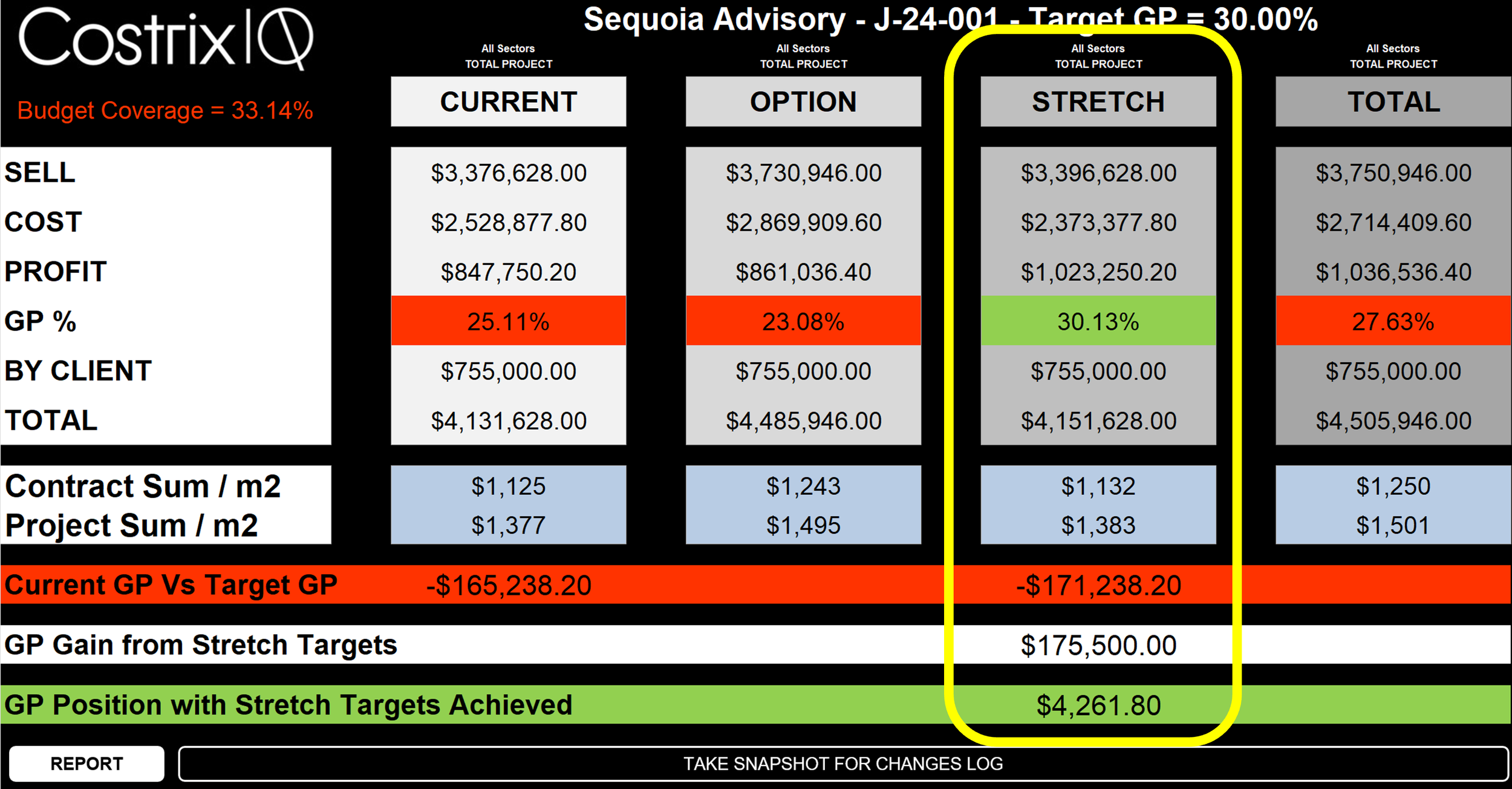
CostrixIQ’s Stretch Opportunity Planning gives opportunity a home inside the cost plan.
Instead of treating upside as hope, STRETCH allows the team to manage opportunity as a pipeline. This changes the way opportunity is managed. It becomes deliberate, visible, and accountable. The team can see what upside exists, what has been secured, what remains open, and where further action is needed. For leadership, this creates a clearer view of margin potential and improvement strategy.
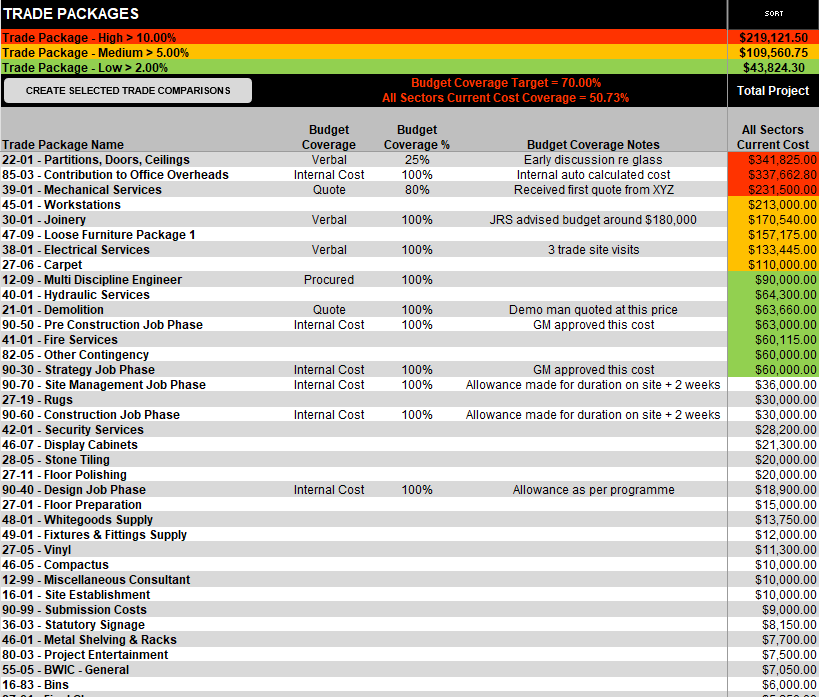
BUDGET COVERAGE RISK MITIGATION
Preventing silent omissions and late shocks
One of the most dangerous risks in cost planning is missing scope or under-allowances. Not because it is complex, but because it is often invisible until it is too late.
A cost plan can look controlled while still carrying hidden exposure if scope has not been properly covered or allowed for. The issue may only surface when design develops and subcontractor quotes arrive misaligned to budget.
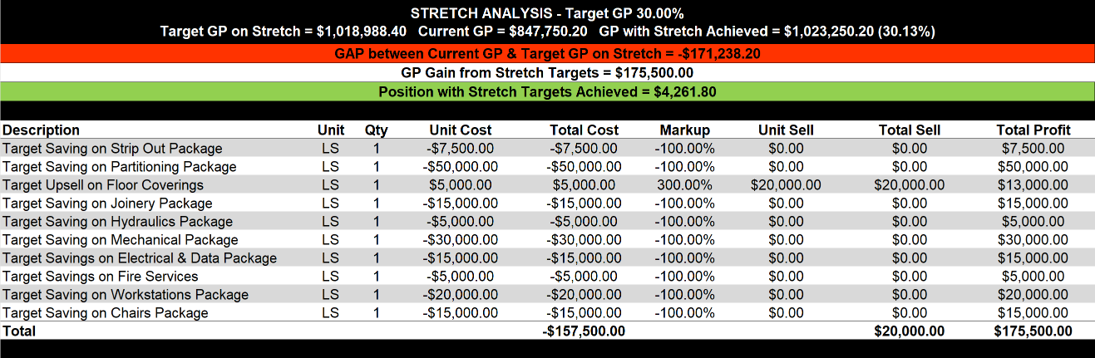
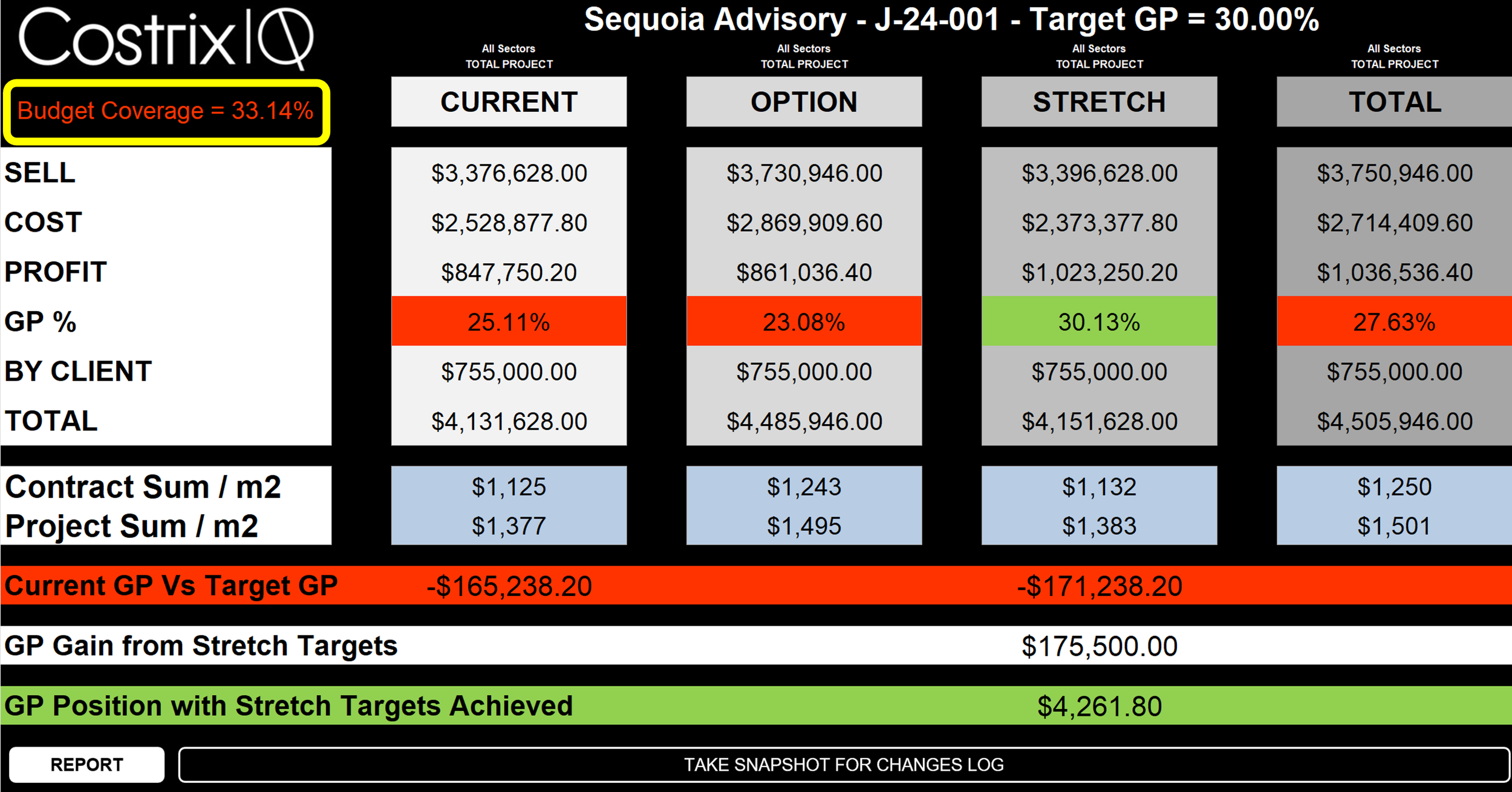
CostrixIQ’s Budget Coverage functionality helps manage this risk by ensuring each scoped package is consciously dealt with. The objective is to make sure scope is not accidentally missed and the correct allocations have been made.
For project teams, this creates discipline. For executives, it gives confidence that the headline number has coverage behind it.
CHANGES LOG DISCIPLINE
Protecting trust as the plan moves
Cost movement is not the problem. Unexplained cost movement is.
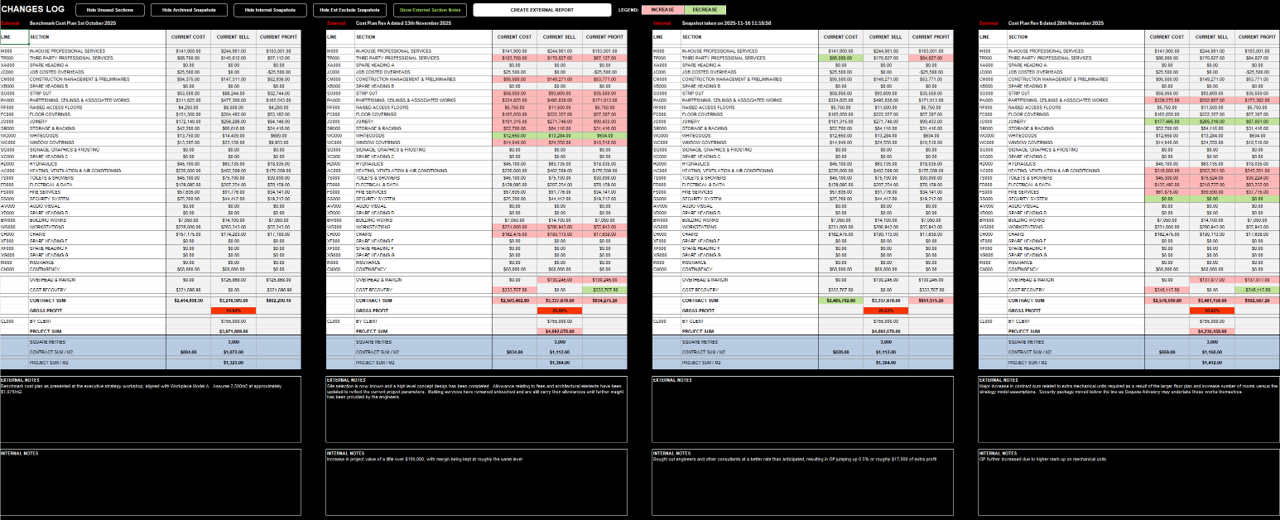
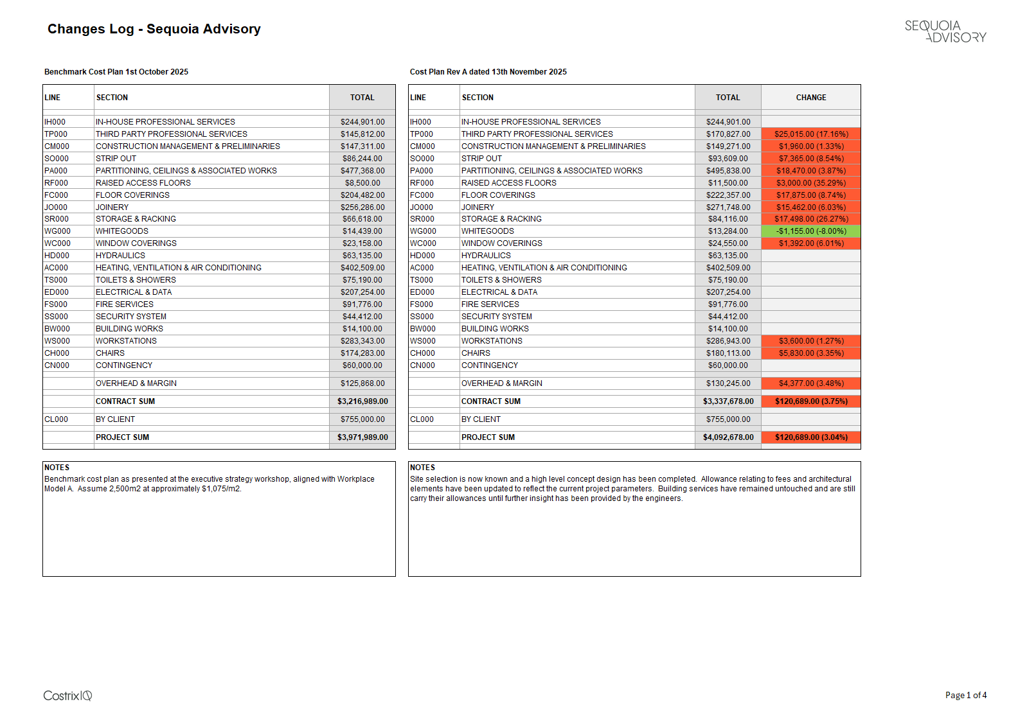
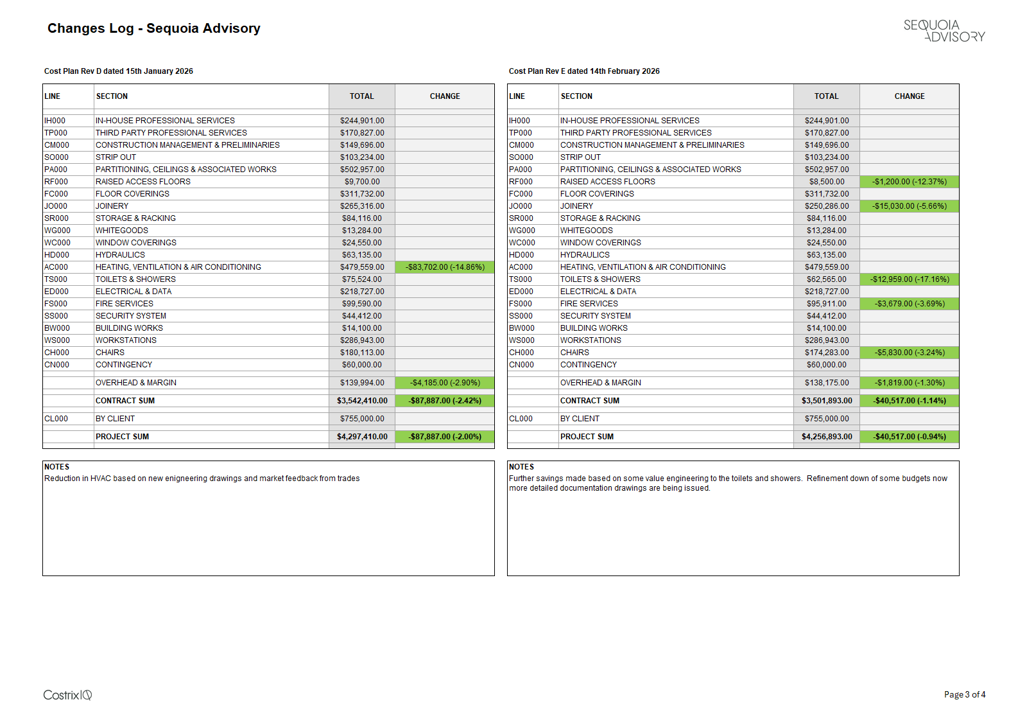
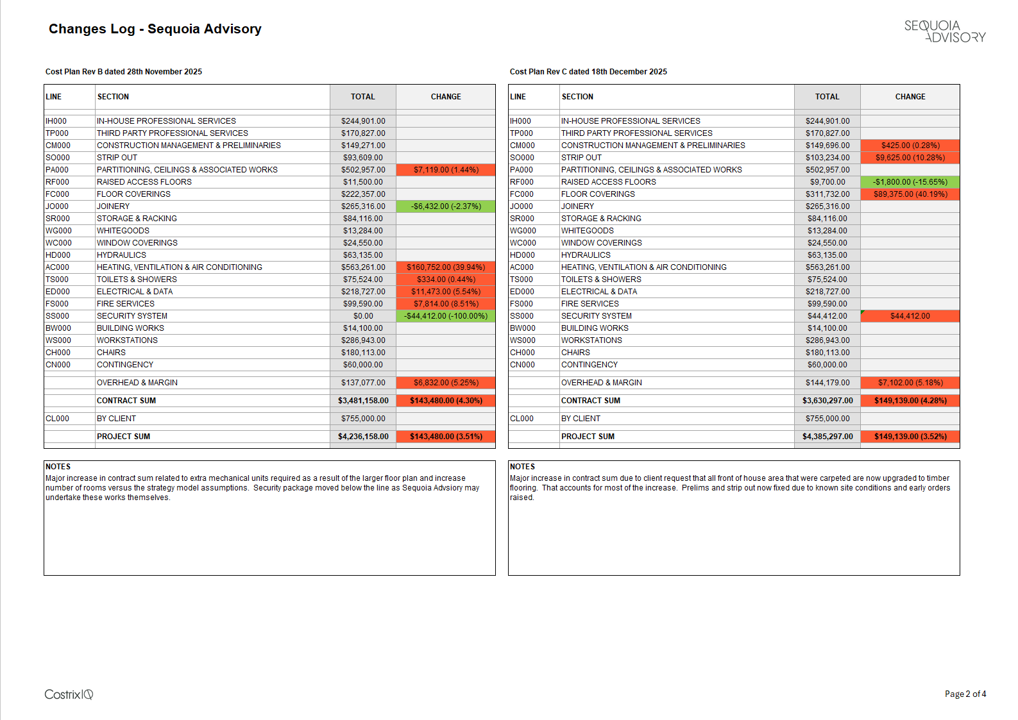
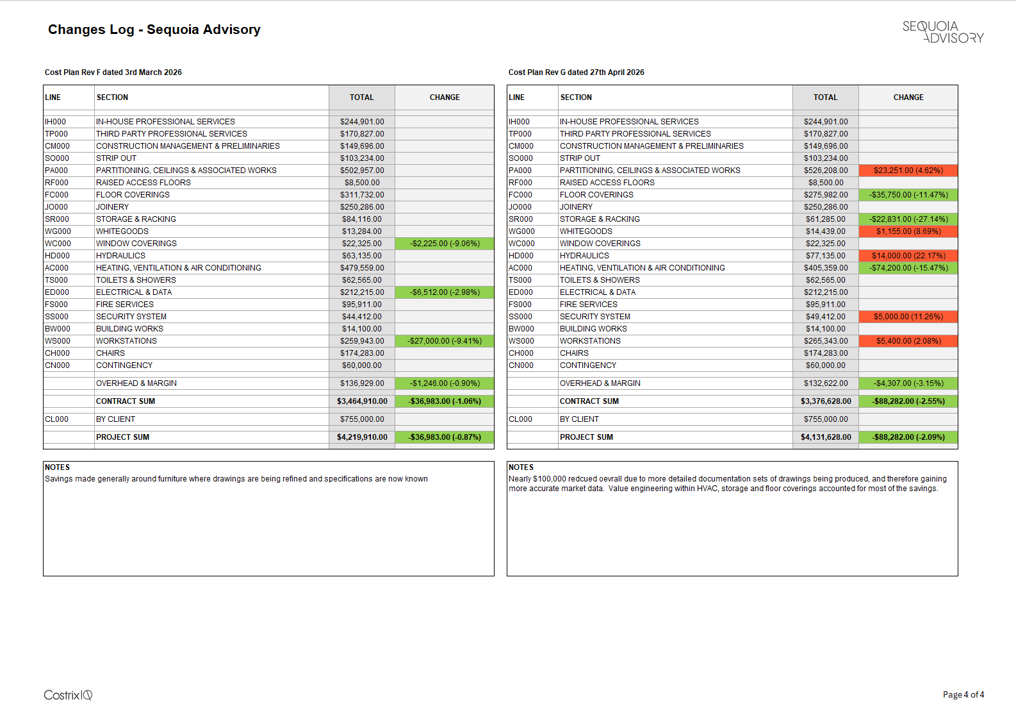
As a project evolves, the cost plan will change. Scope develops, assumptions are replaced, risks are mitigated, opportunities are captured, and client decisions affect the position. If those movements are not documented clearly, the client can experience normal progression as inconsistency.
CostrixIQ’s Changes Log provides a structured record of:
What moved, why it moved, when it moved, by how much, and what decision or event caused the movement.
This protects trust because it turns movement into a managed story. Instead of asking “why has the number changed?”, the client can see the trail of decisions, design development, risk movement, and opportunity capture.
Internally, the Changes Log also supports governance. It gives leadership and delivery teams a clearer view of how the position has evolved and what has shaped the final cost plan.
SCENARIO PLANNING & OPTIONING
Turning uncertainty into pathways
Risk and opportunity should not only be listed. They should be used to guide decisions.
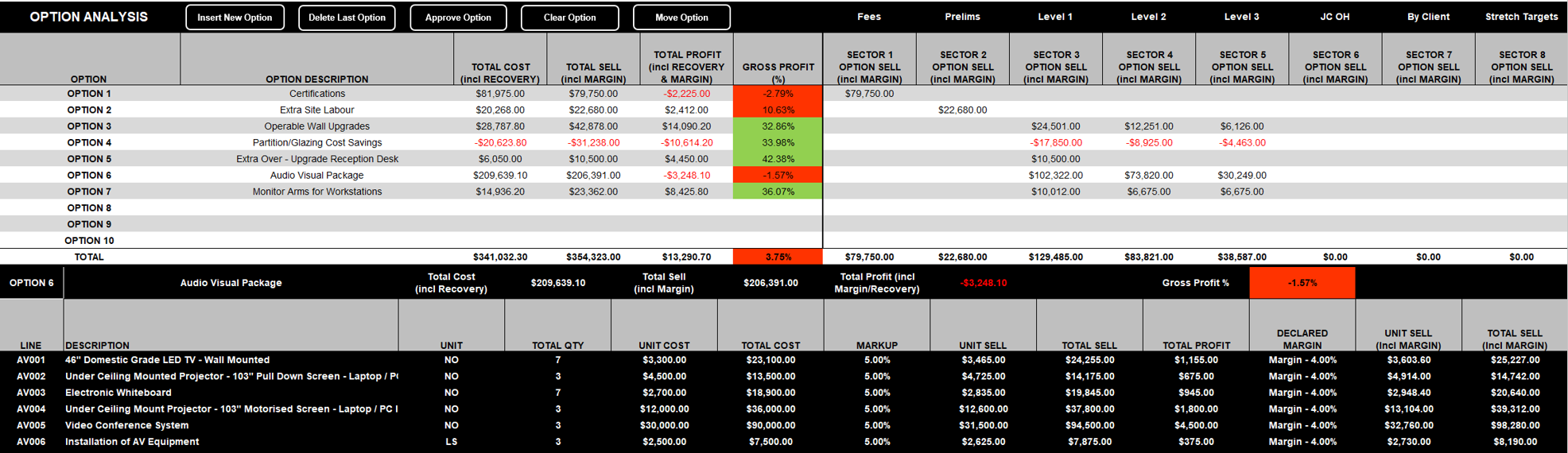
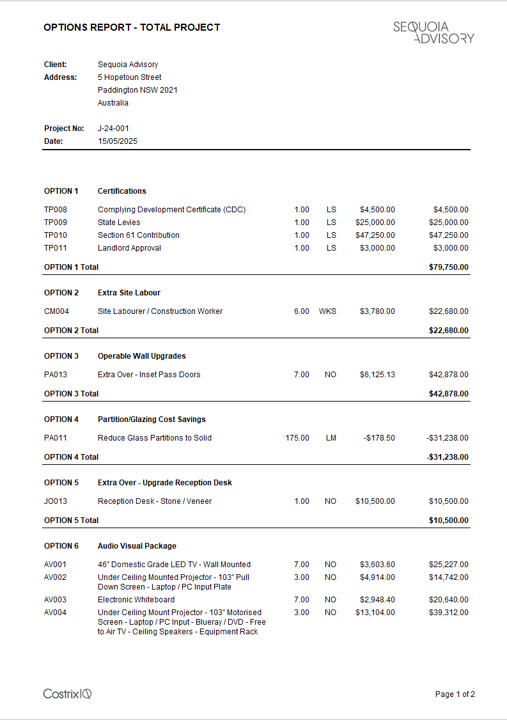
CostrixIQ’s Sectors, Multi-Sectors, and Optioning functionality allows teams to model different pathways and present the financial implications clearly. This is particularly powerful when scope, staging, specification, or client priorities are still moving.
Teams can use these tools to show:
Baseline position, savings options, enhancement options, staged pathways, sector or zone-based scenarios and alternative procurement or delivery strategies.
This helps the client understand what is possible, not just what has already been designed. It also allows the contractor to frame risk and opportunity as a decision-making process rather than a reactive issue.
The result is a more constructive conversation: here is the current position, here are the risks, here are the opportunities, and here are the choices available.


CAPTURING NON-ON-SELLABLE JOB COSTS
Preventing margin leakage before it happens
Not every cost incurred by a contractor can be directly on-sold to the client. Some job-related costs are necessary to deliver the work, manage the process, support the team, or protect the commercial position, but they may not sit neatly in the client-facing scope.
If these items are not captured early, they can quietly erode margin later.
CostrixIQ provides a way to cost plan these internal or non-on-sellable items so they are visible within the true cost base. This helps ensure the commercial position reflects the actual cost of delivering the project, not just the cost of the client-facing scope.
This is important because margin leakage often happens through items that were known, but not formally allowed for. By capturing them early, the team can make informed decisions about recovery, margin, allowance, or internal management before those costs become unavoidable.

EXECUTIVE PORTFOLIO DASHBOARDS
Reducing micromanagement by making the thinking visible
Leadership does not need every detail. But they do need to understand the position behind the number.
CostrixIQ’s Portfolio Dashboards can support executive visibility across multiple projects into:
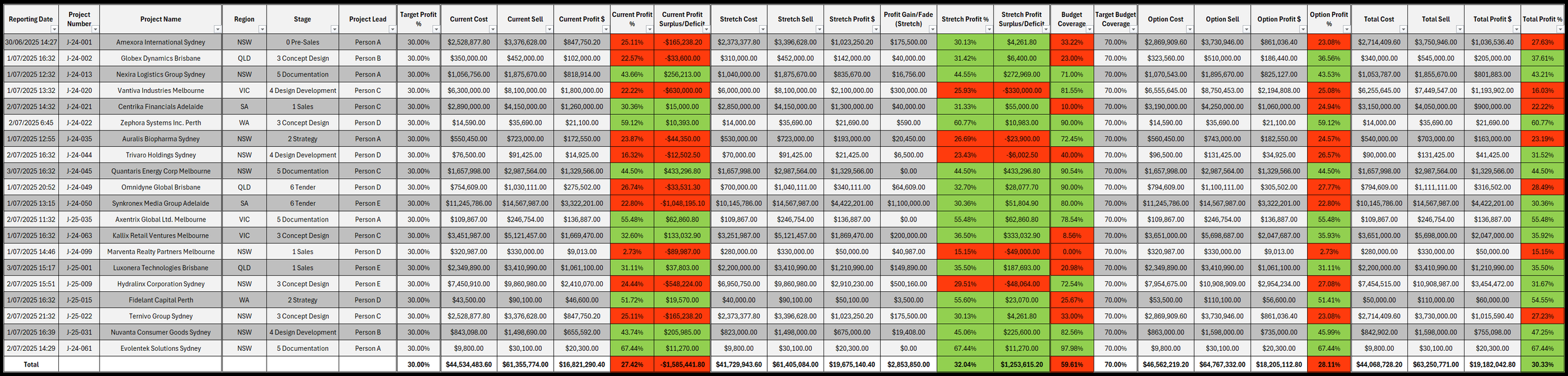
Current position, stretch targets and position, budget coverage, optioning to the client, and project trends over time.
This reduces the need for constant interrogation. Instead of asking repeated questions to understand whether the plan is reliable, leaders can see the thinking, movement, and sensitivity in a structured way.
At a portfolio level, this becomes even more powerful. Executives can compare projects more consistently, identify common risk themes, identify trends, understand where opportunity exists, and intervene earlier where support is required.