
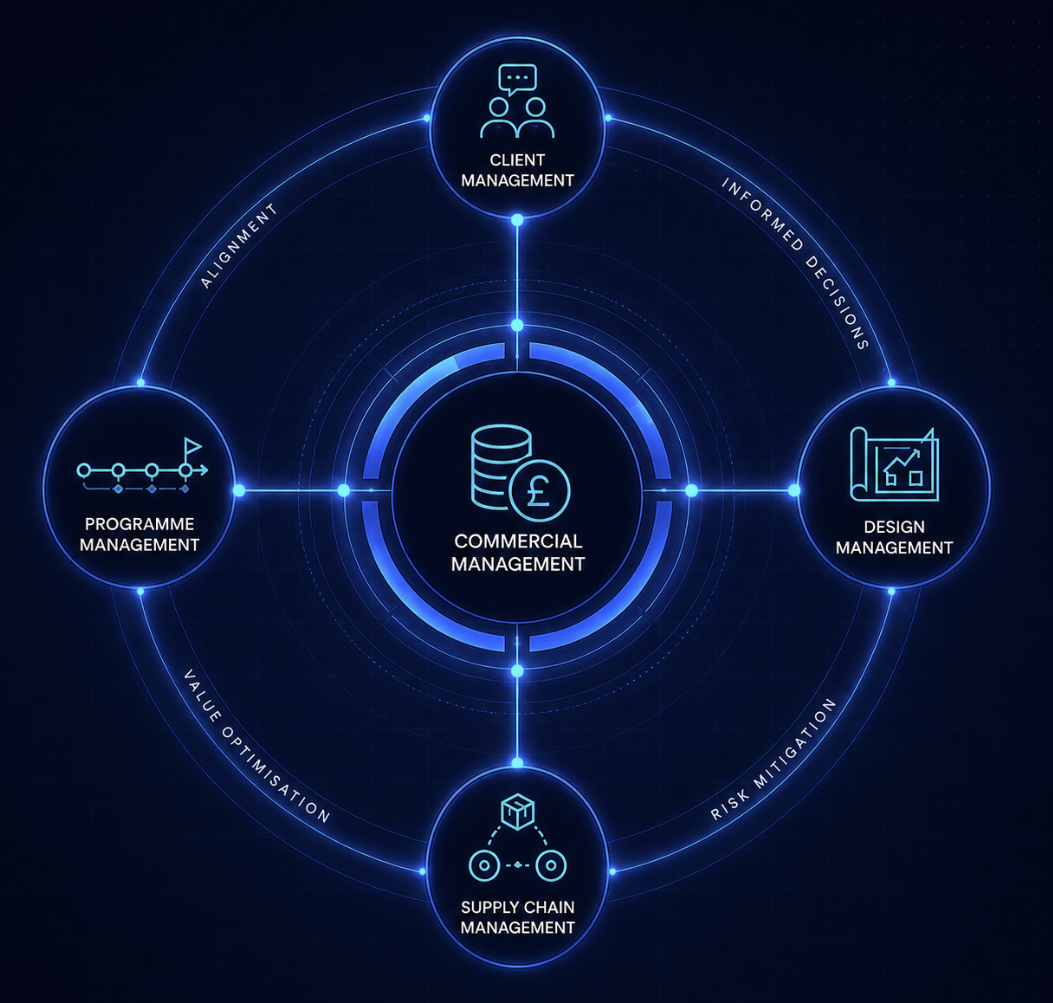
The commercial position is both a view of where the project stands and a basis for exploring where it could go. It reflects decisions made across pre-construction, while scenarios allow the team to test different choices before committing to them. That exchange helps the team decide where to focus, what to investigate and how to shape the work ahead.
The central idea
Understand the position. Shape the possibilities.
This model connects five management disciplines: Client Management, Design Management, Programme Management, Supply Chain Management and Commercial Management. Each contributes something essential. Commercial Management sits at the centre of a two-way exchange: client priorities, design development, programme choices and supply chain information shape the commercial position, while commercial scenarios help shape the strategies pursued across those four disciplines. The team can use this understanding both to respond to change and to explore possibilities in advance.
The current commercial position provides a reference point: what the project is expected to cost, what the client is being asked to pay, the margin that remains, and the assumptions, risks and opportunities behind those figures. Its usefulness depends on understanding how much is supported by evidence and what remains uncertain.
From that reference point, the team can develop scenarios before a problem arises or a preferred approach is fixed. What might a different specification, package strategy or delivery sequence make possible? Comparing the expected effects on cost, client price, contractor margin, time and risk helps identify which options deserve further work. This is as relevant to improving a sound position as it is to addressing a gap.
Those scenarios give the four disciplines practical directions to explore. Client Management can frame choices around priorities and affordability. Design Management can investigate alternatives within an agreed cost range. Programme Management can test sequencing and the timing of commitments. Supply Chain Management can assess package boundaries, market capacity and procurement timing. Each discipline brings the expertise needed to establish whether an option is feasible and worthwhile; commercial thinking informs that judgement alongside quality, safety and delivery requirements.
The results feed back into the commercial core. Design development, client decisions, programme testing and market evidence may confirm a scenario, change its assumptions or rule it out. The team then updates its understanding and refines the strategy. Scenarios remain distinct from the agreed position until the necessary evidence and decisions support their adoption.
The value comes from keeping this exchange active: understand the position, explore possible directions, test them through the disciplines and carry the resulting decisions back into the work.
Understand the position
- Is the proposed scope aligned with the client's budget and priorities?
- Does the forecast cost, assessed against the proposed sell price, support the contractor's required margin?
- Which parts of the position are supported, and which remain assumed?
- What exposure remains, and which opportunities are still unproven?
- Which upcoming decisions will increase commitment or reduce flexibility?
Decide how to respond
- Progress the client decisions that the evidence can support.
- Direct design effort towards the issues that most affect the outcome.
- Align information releases and procurement with the time available.
- Focus market engagement where it can most improve understanding.
- Give material issues an owner, a decision date and a clear next action.
Commercial clarity earns its place at the centre when it helps the team decide what to do next.
The commercial core
Read the position behind the number.
Client affordability and contractor margin need to be understood separately. A project may meet the client's budget while leaving the contractor exposed. Equally, a cost plan may show the required margin on a price the client cannot accept. A workable pathway needs to address both.
The basis of the forecast matters just as much. Budget coverage, scope definition, trade qualifications, programme assumptions and remaining risk determine how much weight the team can place on the reported result. A possible saving belongs in the opportunity discussion until there is sufficient evidence to include it in the secured position.
The source of a problem should shape the response. A confirmed cost increase may require a commercial or design decision. An uncertain allowance may require investigation. A scope mismatch may require clarification. These issues can look similar in a headline report, but pursuing savings in response to all three would send the team in the wrong direction.
Commercial management provides this context while the relevant people retain responsibility for their decisions. Client priorities, technical requirements and delivery obligations remain part of the judgement. The disciplines also work directly with one another; the commercial core gives their decisions a common reference point.
01 — Client Management
Guide expectations and decisions using a position the team can support.
Client management establishes what matters to the client, who needs to decide, and what must be agreed for the project to progress. Those priorities shape the commercial work from the outset. The team needs to understand whether the client values a particular completion date, a specification, future flexibility or a firm capital limit, and where trade-offs are possible.
Commercial clarity then shapes how the conversation is led. Where scope, budget and evidence are aligned, the focus may be confirming choices and maintaining momentum. Where a gap is established, the client needs understandable options and their consequences. Where the position remains uncertain, the conversation should explain what needs to be confirmed and how that will affect the next decision.
The distinction matters. An unresolved allowance should not be presented with the confidence of an agreed price. Equally, a confirmed affordability problem needs a decision; repeatedly describing it as uncertainty will not resolve it.
Internal understanding should support a consistent client explanation, with information appropriate to each audience. The client can understand the scope, price, assumptions and choices without needing the contractor's internal margin detail.
Client decisions then feed back into design priorities, programme requirements, supply chain activity and the cost plan. Their effect needs to be carried through the process so the team delivers on the same understanding the client has approved.
02 — Design Management
Focus design effort where it can most improve the outcome.
Design management coordinates the brief, consultants, technical interfaces and information needed to develop a buildable solution. Commercial input helps the team see the consequences of that developing solution while there is still room to influence it.
Where the design is commercially supported, the priority may be protecting agreed value, resolving interfaces and completing the information needed for procurement. Where an affordability or margin gap is established, the team may need to revisit the significant cost drivers: structural choices, services strategy, façade specification, spatial efficiency or delivery complexity.
Where evidence is weak, further design definition or specialist advice may be more useful than immediate redesign. Cutting scope before understanding the cause of a problem can consume time without correcting the position.
The relationship works both ways. Design management tells the commercial team which decisions are settled, which remain open and where further development could change the cost. Commercial feedback helps determine which alternatives deserve investigation and when their implications need to be understood.
The useful question is whether the next design decision moves the project towards an outcome the client values and the team can deliver commercially. That requires consideration of quality, buildability, time and risk alongside price.
03 — Programme Management
Use commercial understanding to test the timing of decisions and commitments.
Programme management connects the pre-construction activities required to reach contract with the intended sequence of delivery. Client approvals, design information, trade engagement and procurement decisions all need dates that reflect their dependencies.
Those dates carry commercial consequences. A delayed design release may shorten the time available for market engagement. An earlier order may help secure a lead time but commit the team before scope is sufficiently defined. A longer delivery period may affect site overheads, while acceleration may introduce premiums or change how the work is packaged.
Commercial clarity helps the team assess these choices together. If an important package is well defined and adequately supported, an earlier commitment may be worth considering. If the same package carries unresolved interfaces, the priority may be closing the information gap or agreeing a more limited release. The assessment needs to consider the cost of waiting alongside the exposure created by committing.
Programme management brings delivery logic and dependencies to that assessment. Commercial management brings visibility of the associated cost, assumptions and exposure. The resulting action might be an earlier client decision, a different information release, resequencing or a revised allowance.
Time becomes part of the commercial strategy when the team understands which decisions are required, by when, and what happens if they are deferred.
04 — Supply Chain Management
Engage the market with a clear purpose.
Supply chain management develops the package strategy and relationships needed to obtain specialist input, establish credible pricing and assemble the capacity to deliver. It brings the market's knowledge into the project as the scope develops.
The commercial position helps determine where that effort should go. A technically uncertain package may benefit most from early specialist involvement. A well-defined package may be ready for competitive pricing. A package with limited availability or a critical lead time may need attention before a larger package that is already well supported.
The response should also reflect what is driving the exposure. A price gap might require a design alternative, a different package boundary, better information or a review of timing. Simply requesting more prices will not necessarily resolve an unattractive scope or an unrealistic programme.
Market returns feed evidence back into the commercial core. Prices need to be read alongside scope, exclusions, qualifications, capability and delivery assumptions before the team can judge what they establish. That assessment may strengthen the position or reveal a decision that belongs with the client, design or programme team.
Supply chain activity is most useful when the team knows what it is trying to learn, which assumption it is testing and how the answer will affect the next decision.
The thinking in practice
The same mechanical budget gap can call for different strategies.
Consider an illustrative mechanical-services package covering heating, cooling and ventilation. The first trade return is above the cost-plan allowance. The next step is to establish what is driving the variance: missing scope, a changed design basis, delivery assumptions or a combination of these. The cause should shape the work that follows.
If the allowance omitted controls integration or commissioning requirements, the first task is to establish a complete scope comparison. Design and supply chain management clarify what is required, what the return includes and which package owns each item. Commercial management reconciles gaps and overlaps and updates the forecast cost and margin. Moving an item between packages does not remove its cost. Any remaining affordability gap needs a clear client conversation about the available choices.
If a revised occupancy or operating brief has changed the mechanical design, the team first confirms the agreed performance requirements and how the proposed solution differs from the allowance. The responsible designers and specialists can then assess technically acceptable plant and distribution options. Commercial management compares their overall cost, programme and operational implications, while client management clarifies which outcomes must be protected. A cheaper selection is only a useful option if it meets the agreed requirements.
If the return includes a premium for accelerated plant delivery, programme and supply chain management test the required date against design releases, site access, installation and commissioning. The commercial team can compare an earlier order, an acceptable alternative selection or a revised installation sequence, including the exposure of committing before scope is settled and any costs created elsewhere. A lower plant price is not necessarily a lower project cost.
The same thinking can start before a quotation exposes a gap. Commercial scenarios can test alternative plant selections, procurement dates or installation sequences in advance. They give the client choices to consider, the design team options to investigate, the programme team sequences to test and the supply chain team assumptions to validate. The findings then feed back into the commercial position and help refine the strategy.
The headline variance may look the same in each case, but the appropriate action is different. Several causes may also occur together. The commercial contribution is to distinguish them, test possible directions and coordinate the decisions needed across the disciplines, keeping the agreed position separate from options whose feasibility or savings remain unverified.
Once a decision is made, it needs a named implementation owner. The mechanical design, package scope, controls interfaces, procurement dates, installation and commissioning programme, and cost plan must reflect the agreed approach. An option remains a proposal until the relevant approvals, evidence and actions give the team a basis to rely on it.
Keeping the process connected
Make the commercial review a point of decision.
A regular review gives the disciplines a place to bring material changes together. Its timing should follow the pace of the project and the decisions approaching. Significant new information may require attention between scheduled reviews.
The discussion should establish what changed, how reliable the current position is, which disciplines are affected and whether the existing strategy still holds. Where action is required, agree the owner, the decision date and the evidence needed to close the issue. Keep the distinction between the agreed position and unresolved options visible.
This discipline can be applied through the meetings, responsibilities and specialist tools the team already uses. It depends on people contributing current information and carrying decisions back into their work.
Some movement will confirm that the current approach remains sound. Other movement will justify intervention. Good commercial judgement helps the team distinguish the two and focus its effort accordingly.
The commercial outcome
Better connections improve the quality of decisions.
Stronger alignment
The client brief, developing design, programme and procurement approach remain connected to a shared understanding of what the project can support.
Better informed decisions
The team considers the evidence and consequences before committing, with assumptions and unresolved choices clearly identified.
Earlier risk mitigation
Exposure prompts investigation and action while the relevant design, timing or procurement choices remain available.
More deliberate value optimisation
Effort is directed towards the choices that improve the whole project outcome, considering cost, quality, time and risk together.
Better margin protection
The contractor can distinguish supported performance from a position dependent on missing scope, weak allowances or prospective savings.
Greater continuity into delivery
The agreed position carries the assumptions, decisions and remaining actions that delivery needs to understand and manage.
Where CostrixIQ contributes
Commercial clarity that supports the wider process.
CostrixIQ supports the commercial core through structured cost planning, budget coverage, options, trade comparisons, margin visibility and a record of cost plan movement. Its reporting helps teams communicate the relevant parts of that position to the people making decisions.
Some contributions are direct, such as preparing client reports or comparing trade returns. Others work through the commercial understanding those activities create: helping a design manager focus an options review, a programme manager assess the cost implications of timing assumptions, or a supply chain lead identify packages requiring further market evidence.
Those connections depend on the information and judgement the team brings to the process. CostrixIQ supports the commercial work; responsibility for client relationships, technical design, programme management and the wider procurement process remains with the relevant people and their specialist tools.
From understanding to action
Put commercial clarity to work across pre-construction.
The purpose of a commercial core is to help the team understand the consequences of its choices while it can still influence them. Client, design, programme and supply chain management contribute to that understanding and use it to decide where to focus next.
A clearer position may strengthen confidence in the current strategy. It may reveal a need for better evidence, a different option or an earlier decision. The value lies in making that judgement deliberately and carrying it through the work.
When the commercial position changes, the team should reassess what that means for the strategy.